




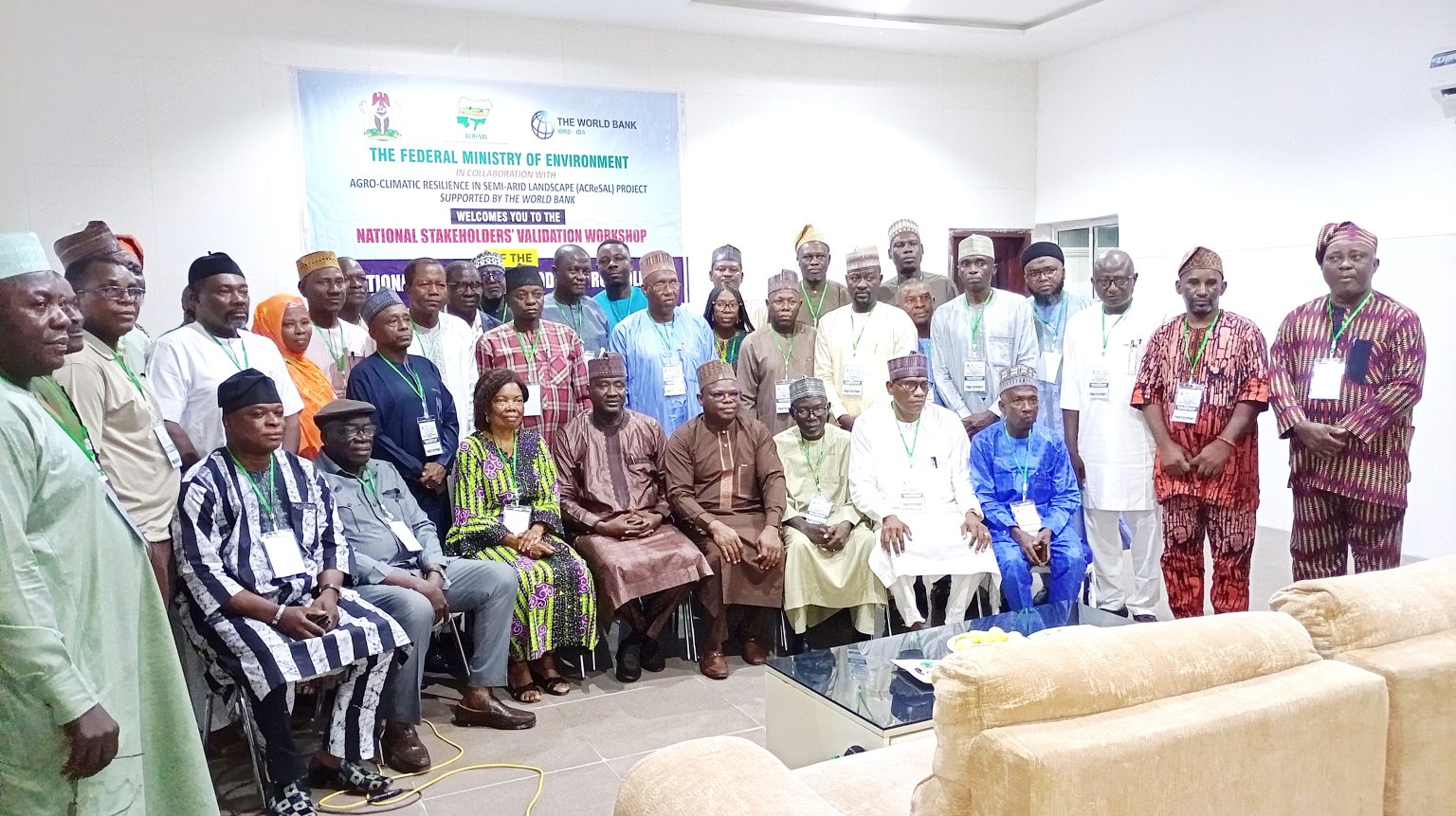
In a renewed effort to confront the persistent challenges of erosion, flooding, and environmental degradation, the Federal Ministry of Environment has validated the revised National Erosion and Flood Control Policy (NEFCOP) — a landmark framework designed to strengthen Nigeria’s response to climate and environmental risks.
The validation, which took place at the National Stakeholders Validation Workshop in Nasarawa State, brought together government officials, environmental experts, researchers, and development partners. The exercise marks a major step toward updating the national strategy originally launched in 2005, to reflect current realities and integrate modern approaches to erosion and flood control.

Renewed Policy for a Changing Environment
Speaking at the event, the Permanent Secretary of the Federal Ministry of Environment, Mahmud Kambari, reaffirmed the government’s commitment to building a climate-resilient Nigeria through evidence-based policies and coordinated action.
“Environmental sustainability is not an option; it is an imperative for our survival and national development,” Kambari stated. “As we validate these critical policy instruments today, we must also commit to their full implementation, monitoring, and periodic review.”
He explained that the revised NEFCOP provides a comprehensive framework for managing erosion and flood risks, while promoting integrated land and water resource management and strengthening institutional coordination across all levels of government.
Kambari noted that the updated policy aligns Nigeria’s environmental management efforts with global frameworks, including the Paris Agreement, the Sendai Framework for Disaster Risk Reduction, and the UN Decade on Ecosystem Restoration.

“The documents before you today are products of extensive technical consultations and stakeholder inputs at various levels,” he said.
“Let us ensure that the policy reflects our national realities, addresses identified gaps, and provides practical solutions that can be implemented across different ecological zones and administrative contexts.”
Building Resilience through Collaboration
In his remarks, the Director of the Erosion, Flood and Coastal Zone Management Department, Mr. Usman Bokani, described the validation workshop as a critical milestone in the government’s effort to strengthen resilience against the growing impacts of erosion and flooding.
According to him, the review process was inclusive and participatory, drawing insights from technical experts, research institutions, civil society, and community stakeholders across the federation.
“This review was undertaken with broad consultations and the active participation of experts and institutions from across the country,” Bokani explained. “The aim is to ensure that the policy integrates modern technologies, aligns with both national and international frameworks, and provides practical solutions for erosion and flood risk management”.
He added that the insights generated from the workshop will serve as final inputs to strengthen the policy before its formal adoption and implementation.
Development Partners Reaffirm Support
Representing the National Project Coordinator of the Agro-Climatic Resilience in Semi-Arid Landscapes (ACReSAL) project, Mr. Musa Shuaibu reaffirmed the organization’s support for the revised policy. He emphasized its importance in guiding both structural and non-structural interventions to reduce environmental risks and enhance community adaptation.
> “This policy is critical to ensuring that interventions are sustainable, data-driven, and aligned with Nigeria’s long-term environmental goals,” he said.
Also speaking at the workshop, Dr. (Mrs.) M.A. Oyeleke highlighted the importance of the validation process in ensuring that all stakeholders clearly understand the policy, particularly in terms of information, data management, and implementation strategies.
Addressing Environmental and Developmental Challenges
Nigeria continues to face severe environmental threats — including land degradation, flooding, and coastal erosion — which have displaced thousands, destroyed farmlands, damaged infrastructure, and disrupted livelihoods across the country.
Recognizing these challenges, the Federal Ministry of Environment emphasized that erosion and flood control are not just environmental issues, but developmental, social, and economic concerns that require coordinated national action.
The revised NEFCOP sets out key objectives, including:
Preventing and mitigating the impacts of erosion and flooding;
Promoting sustainable land use and water management practices;
Enhancing community resilience and adaptive capacity;
Strengthening intergovernmental coordination; and
Aligning Nigeria’s environmental policies with international best practices.
A Call to Action
While expressing appreciation to ACReSAL, the World Bank, and other development partners for their support in driving the policy process, Permanent Secretary Mahmud Kambari called on all tiers of government, private sector actors, and communities to take ownership of the policy’s implementation.
> “The Ministry will continue to provide leadership and coordination,” he assured. “But true success will depend on how effectively we all play our roles at the federal, state, and local levels.”
He concluded by urging stakeholders to view the policy not merely as a document, but as a living framework that must be actively implemented, monitored, and periodically reviewed to adapt to emerging environmental realities.
Towards a Climate-Resilient Future
The validation of the revised National Erosion and Flood Control Policy (NEFCOP) symbolizes Nigeria’s renewed determination to build a sustainable and climate-resilient future. Through strengthened institutions, informed policy actions, and collaborative partnerships, the nation aims to reduce vulnerability, safeguard livelihoods, and protect its natural environment for generations to come.