




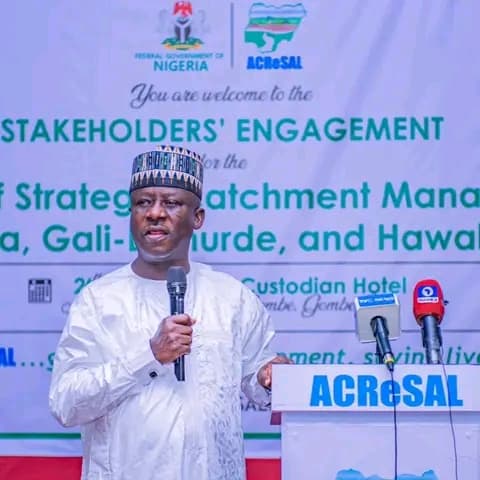
The final phase of the Agro Climatic Resilience In Semi Arid Landscapes (ACReSAL) stakeholders’ engagement for the development of 20 Catchment Management Plans has kicked off in Gombe State, drawing participation from key institutional stakeholders across seven states—Adamawa, Bauchi, Borno, Taraba, Yobe, Plateau, and Gombe.
The engagement focuses on the Gaji-Lamurde, Hawal-Kilunga, and Gongola catchments, with discussions centered on harnessing opportunities and tackling challenges in these critical water systems.

This milestone marks the concluding stage of a nationwide process to develop 20 Strategic Catchment Management Plans, an initiative supported by the ACReSAL Project in collaboration with the Federal Government of Nigeria. To date, nine plans have been developed and validated, while stakeholder consultations have been concluded for eight other catchments.
Speaking at the event, the National Project Coordinator, Abdulhamid Umar, noted that the catchment plans are anchored on a shared vision from stakeholders, ensuring that local voices shape interventions. He stressed that the process would help attract investments and guarantee that project benefits are felt directly within communities.
Also present, the Gombe State Commissioner for Water, Environment, and Forest Resources, Mohammed Said Fawu, described the engagement as timely and well-aligned with the state’s environmental priorities. He pointed to the Gombe Goes Green initiative, which—supported by ACReSAL—has seen the planting of more than five million trees in the last five years, as proof of the state’s commitment to environmental renewal.
On his part, the Gombe State Project Coordinator, Amb. Sani Adamu Jauro, highlighted the role of the catchment management plans in boosting agriculture, improving livelihoods, and strengthening policies for sustainable natural resource management.
The engagement drew a diverse audience, including Royal Fathers, ACReSAL Project Coordinators, government agencies, NGOs, academia, and other institutional stakeholders, all united in their commitment to sustainable water and land management.