


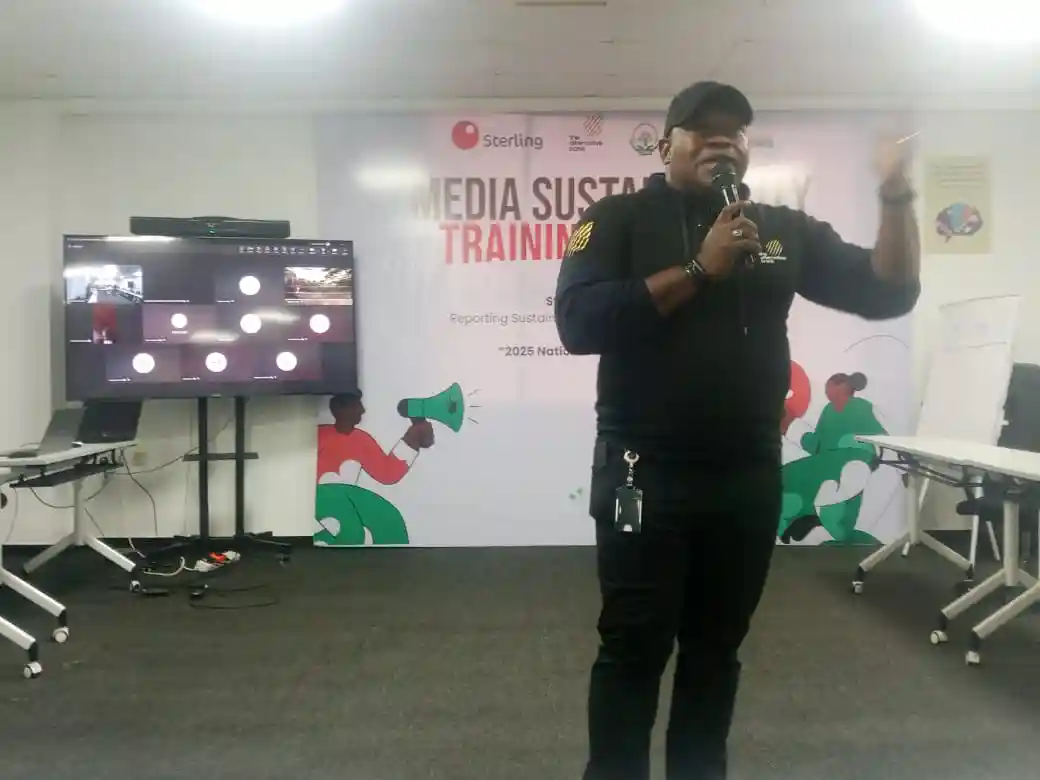
Media professionals across west African nation, Nigeria, on Tuesday and Wednesday, converged in Abuja for a high-level sustainability training organised by the Sterling Sustainability Working Group (SWG), a Sterling Holding Company under Sterling Bank and Alternative Bank, in partnership with Climate Africa Media Initiative and Centre (CAMIC).
The workshop was held to commemorate the 2025 National Sustainability Week and aimed at strengthening journalists’ capacity to report environment and sustainability issues with depth, accuracy, and impact.

The aim of the training was for reporters, editors, broadcasters, and media executives to gain practical insights into sustainability reporting in an era of climate urgency, innovation, and development.
Seasoned media and sustainability facilitators that included Bunmi Ajiboye, the Head of the Sterling Sustainability Working Group;
Akogun Ishiak Ajibola, former Managing Director of Daily Trust; Aliu Akoshile, Publisher of NatureNews Media, Pius Alabi, and Victoria Bamas, Editor at the International Centre for Investigative Reporting (ICIR) took turns in lecturing participants through critical sessions on the role of journalism in promoting sustainability, integrating environmental reporting into everyday newsroom practice, leveraging artificial intelligence for content creation and distribution, and understanding corporate sustainability and CSR initiatives.
Sterling Bank also shared insights into its sustainability efforts spanning renewable energy financing, climate-smart agriculture, community development, environmental conservation, and financial inclusion.
Bunmi Ajiboye emphasised that the decision to train journalists was deliberate, noting that no nation can develop without positive and developmental journalism.
“We believe that this goes beyond training and becomes a cornerstone of how Nigeria tells her story of progress, resilience, and innovation, she said while delivering her welcome address.
“The story is only as true as the person who tells it. It is how the story is told that determines whether it will be believed, retold, and eventually shape culture, behaviour, and society”, Bunmi revealed.
She explained that while impactful sustainability work is important, effective storytelling is what ultimately shapes national consciousness.
“What good is innovation if it isn’t translated into understanding? What good is progress if it isn’t communicated in a way that inspires others? That is why your role as journalists and storytellers is essential”, she added.
She further stressed that sustainability has moved beyond environmental discourse to encompass economic growth, innovation, and people-centred development, urging journalists to use their platforms to ignite action, correct misinformation, and amplify local solutions.
Aliu Akoshile, Publisher of NatureNews Media, noted that sustainability reporting is no longer optional, as audiences increasingly demand accountability from governments and corporations on environmental and social issues.
Victoria Bamas spoke of the importance of investigative journalism in uncovering hidden environmental and social challenges.
Akogun Ishiak Ajibola encouraged media organisations to embrace digital tools and innovative storytelling formats to reach wider and younger audiences, while advocating for financial and editorial sustainability
The training, interactive, featured engaging question-and-answer sessions where participants shared newsroom experiences and challenges, and networking opportunities.
As sustainability continues to dominate global and national conversations, the Sterling Bank-led initiative reaffirmed the media’s role not just as reporters of events, but as key partners in shaping Nigeria’s sustainable future.