




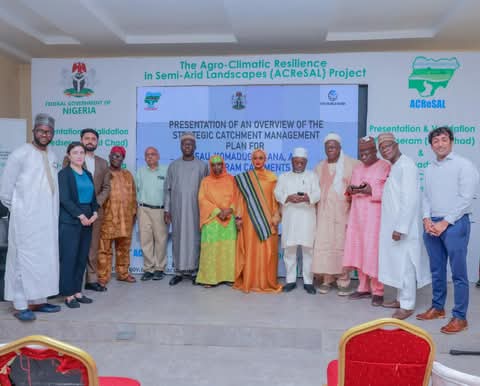
The Stretagic plans will guide government and private sector investment

The Nigerian government through the Agro-Climatic Resilience in Semi-Arid Landscapes (ACReSAL) project, is developing 20 Strategic Catchment Management Plans (SCMPs) to address land degradation challenges in a sustainable and integrated approach.
Nine plans are already developed and validated, with progress made to complete the remaining eleven.Recently, the Yedseram and Misau catchment management plans, covering Adamawa, Jigawa, Yobe, Bauchi, and Borno states, were presented and endorsed by stakeholders during the ACReSAL Project’s Hybrid Implementation Support Mission in Minna, Niger State.
These plans reveal the challenges, economic potentials, and prospects of the catchment areas, aiming to enhance resilience and sustainability through policy formulation and implementation.Nigeria’s Minister of Water Resources and Sanitation, Prof. Joseph Terlumun Utsev described the role of the SCMPs as key to guiding investments and achieving integrated watershed management.

“The SCMPs are not just technical documents; they are the very compass of the ACReSAL Project implementation”, the Minister, represented by Hijiya Sakinatu Abbo Jimeta, Acting Executive Director, Nigeria Integrated Water Management Commission, said.
According to him, the SCMPs are designed to guide and prioritize investments across all components of the project — particularly Components A and B, stating that “they are the vehicle through which we achieve integrated watershed management, and they form the strategic backbone for landscape-scale resilience in the semi-arid North”.
The Minister further explained that the SCMPs are the mitigation and corrective response, enabling planning, not in isolation, but with a clear understanding of the interactions of all the watershed components including the upstream, midstream, and downstream dynamics, sectoral trade-offs, and climate vulnerabilities that shape each catchment area in an integrated manner.
“The plans will guide investments, support integration across sectors, informed policy decisions, build resilience, improve cost-effectiveness, and account for monitoring and evaluation of efforts.”
“ACReSAL Project is not just about short-term fixes. It is about long-term transformation. It is about restoring dignity to drylands, rebalancing our ecosystems, and strengthening the resilience of millions of people across northern Nigeria. The Strategic Catchment Management Plans are our blueprint — our roadmap — for doing things differently and doing them right. Let us therefore treat them as the strategic tools that they are”.

Task Team Leader of the ACReSAL Project and Senior Environmental Specialist at the World Bank Office, Dr. Joy Iganya Agene noted that the Yedseram and Misau catchments cover approximately 9 million hectares rich in biodiversity and natural resources. She emphasized the need to move from planning to action and implementation, stating that the SCMPs will support national development and growth.”The Yedseram and Misau catchments have a combined total area of 9 million hectares that are rich in biodiversity, natural resources, and other potentials like forest and water resources. We need to move from planning, discussion to action and implementation”, she said.
“ACReSAL is supporting National Development and growth in the area of providing 20 strategic catchment management plans that will help in policy and informed decision-making in the area of budgeting, targeting investment, economy of the country, and tapping into natural resources and how we can manage the challenge of competition for natural resources”, Dr. Agene added.
Nagaraja Rao Harshadeep, Lead Environmental Specialist at the World Bank, highlighted that the SCMPs will set a shared vision for the future, identifying challenges and opportunities.
He said “the strategic catchment management plan will set a motion to get a shared vision for the future from the land, water, agriculture, climate, and social points of view, to identify what the challenges and opportunities are, what are the things that can be done in the short, medium and long terms to address some of the challenges and take advantage of opportunities in the system”.
He called for leveraging technology and youth inclusion in an integrated manner across environment, water resources, climate change, and agriculture. “We should look at the opportunities that are there and what can be done in the long term, not only under ACReSAL but under all programs of the Federal Government”.
National Project Coordinator for ACReSAL, Abduhamid Umar explained that the essence of the plan is to provide roadmaps and classical footprints for developmental efforts in each of the 19 states and the Federal Capital Territory.
“The production of 20 strategic catchment management plans will now give direction, where the Federal Government investment, private sector investments, and the state government investments can easily be guided on the most viable locations”, he said.
These strategic plans will also be useful for other donor organizations in Nigeria and other countries.At the validation mission were Yakubu Mohammed, Commissioner for Environment, Niger State; other commissioners; permanent secretaries; traditional rulers; World Bank Team, Academia, representatives from federal and state ministries, departments, and agencies; and other key stakeholders.