




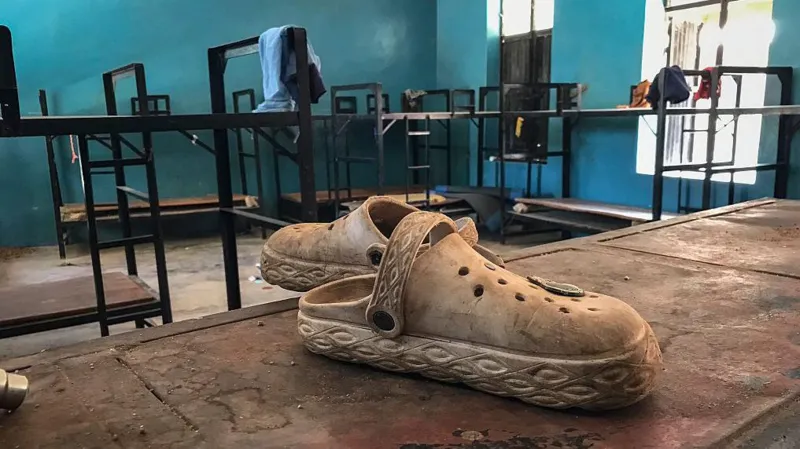
A wave of kidnappings across several Nigerian states has triggered widespread school closures and a massive nationwide security response, after armed groups seized hundreds of children and teachers in multiple attacks.
Officials confirmed that 50 of the 315 students taken from St Mary’s School in Papiri, Niger State managed to escape their captors between Friday and Saturday. The Christian Association of Nigeria reported that the children who fled have now been reunited with relieved family members. Security forces continue searching for the remaining 265 pupils and 12 staff still unaccounted for.

The abduction in Niger State was followed by another attack on Monday in Kebbi State, where 20 more students were seized from a boarding school. In the wake of these incidents, authorities in Kebbi, Niger, Katsina, Yobe, and Kwara ordered many schools to suspend operations.
President Bola Tinubu responded by directing the recruitment of 30,000 additional police officers and ordering police previously assigned to VIP protection to be redeployed to frontline duties, especially in rural regions vulnerable to bandit attacks. VIPs needing protection will now rely on personnel from the Nigeria Security and Civil Defence Corps.
Meanwhile, in Kwara State, 38 worshippers kidnapped from a church service in Eruku were released on Sunday, though two people lost their lives during the initial assault.
The Niger School Attack
Armed men reportedly stormed St Mary’s School around 02:00 local time, abducting students housed in its boarding facility. Early figures underestimated the scale of the attack, but updated counts reveal that the number taken exceeds even the infamous 2014 Chibok kidnapping, when Boko Haram captured 276 girls.

Authorities later accused the school of ignoring previous security warnings instructing boarding institutions to close due to heightened risk. The school has not publicly responded to the allegation.
Governor Mohammed Umaru Bongo announced a region-wide shutdown of schools, saying this was “no time for blame,” while appealing for coordinated efforts to secure the hostages’ release.
Parents spoke of their anguish as they awaited news. One mother, in tears, said two nieces—aged six and thirteen—were among those taken. Another parent described the situation as leaving “everybody weak.”
Growing Fears Amid Rising Insecurity
The surge in mass abductions—driven largely by criminal gangs seeking ransom—has become a chronic crisis in parts of northern and central Nigeria. Though ransom payments are outlawed, the measure has done little to curb the kidnappers’ activities.
The spike in attacks has also reignited international debate. Recently, several U.S. political figures, including former President Donald Trump, have claimed that Christians in Nigeria are being specifically targeted—a claim the Nigerian government strongly rejects. Officials emphasize that militant and criminal groups attack people of all faiths, and that most victims in the north are Muslim, since most violence occurs in Muslim-majority regions.
Experts note that while some violence involves jihadist groups fighting the state, other deadly clashes—particularly between mostly Muslim herders and mostly Christian farming communities—are often fueled by disputes over land and resources, not religion.
Search Efforts Under Way
Soldiers, police, and local vigilante groups are combing forests and remote tracks believed to be used by the kidnappers. President Tinubu has postponed upcoming foreign travel, including a planned visit to the G20 summit in South Africa, to focus on the unfolding crisis.
The escape of the 50 students brought a moment of hope, but with hundreds still missing, the country remains on edge as rescue operations continue.