


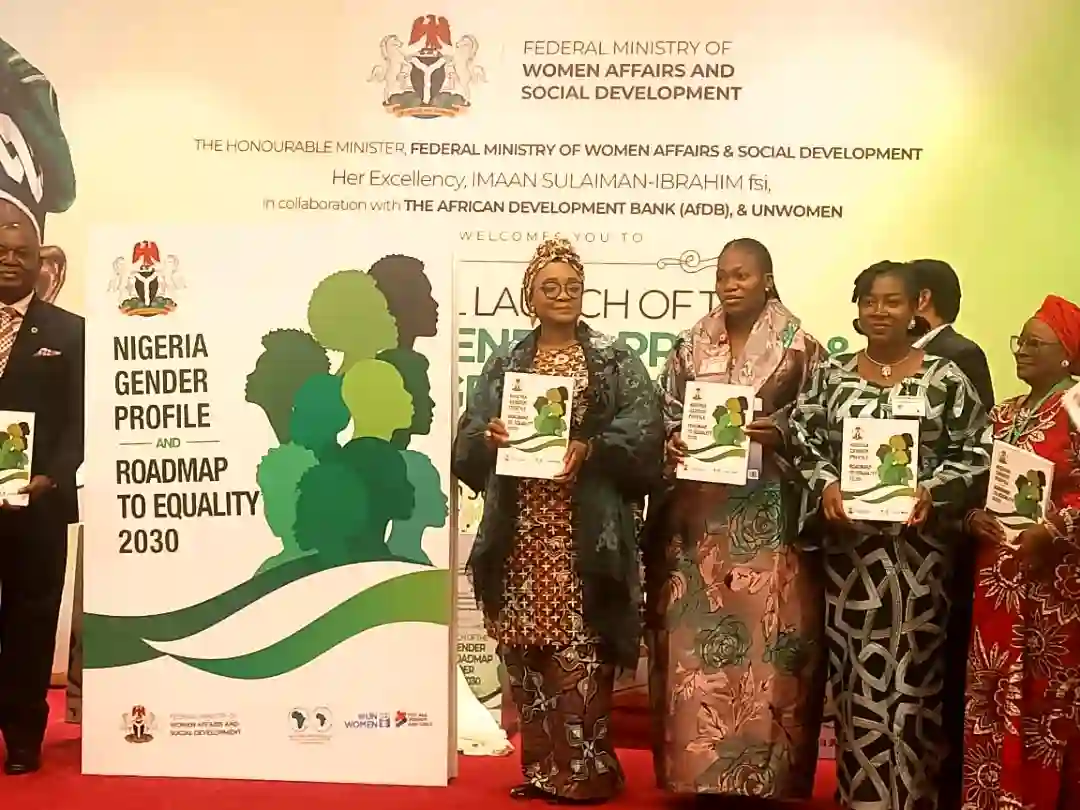
Abuja, June 25, 2026 — The Federal Government has unveiled a comprehensive strategy aimed at tackling gender inequality and accelerating women’s inclusion in governance, education, healthcare and economic activities, with the launch of the Nigeria Gender Profile and Roadmap to Equality 2030.
The document was launched on Wednesday in Abuja at a gathering attended by government officials, development partners, civil society organisations, women’s groups and members of the diplomatic community.

The roadmap, developed by the Federal Ministry of Women Affairs and Social Development with support from the African Development Bank (AfDB) and UN Women, provides a detailed assessment of gender disparities in Nigeria and outlines key actions required to achieve equality by 2030.
Speaking at the event, Minister of Women Affairs and Social Development, Hon. Imaan Sulaiman-Ibrahim, said the initiative represents a major milestone in Nigeria’s efforts to mainstream gender considerations into national development planning. She noted that while women make significant contributions to the country’s social and economic development, many continue to face barriers that limit their access to opportunities and decision-making platforms.
According to the minister, the roadmap is structured around eight priority areas, including institutional reforms, economic empowerment, education, leadership, healthcare, legal protections, climate resilience and the transformation of social norms that perpetuate inequality. She said the framework would serve as a guide for government institutions, development partners and other stakeholders in implementing policies and programmes that promote equal opportunities for all Nigerians.
“The roadmap provides a clear direction for achieving measurable progress on gender equality. It reflects our commitment to ensuring that women and girls are not left behind in Nigeria’s development journey,” she said.
Sulaiman-Ibrahim added that the initiative aligns with several ongoing government reforms, including the National Gender Policy, the National Women’s Economic Empowerment Policy and programmes being implemented under the Renewed Hope Agenda.
Representing the Permanent Secretary of the ministry, Mrs. Sweet Ogunduyile said the launch underscored the government’s determination to address longstanding barriers confronting women and girls.
She stressed that gender equality remains critical to national development and called for collective action to address issues such as gender-based violence, unequal educational opportunities and the limited participation of women in leadership.
“The progress of any nation depends on the inclusion of all its citizens. We must continue to create opportunities that allow women and girls to reach their full potential”, she said.
In her institutional remarks, UN Women Country Representative to Nigeria and ECOWAS, Ms. Beatrice Eyong, described the roadmap as a vital tool for advancing inclusive development and achieving the Sustainable Development Goals.
She observed that despite Nigeria’s vast human and economic potential, persistent inequalities continue to affect women across several sectors.
Eyong pointed to low female representation in political leadership, economic exclusion and the impact of poverty and climate-related challenges on women as some of the issues highlighted in the Gender Profile.
She emphasized that investing in gender equality would yield benefits far beyond women’s empowerment, contributing to stronger institutions, economic growth and social stability.
Also speaking, Dr. Abdul B. Kamara, Acting Vice President and Director General for Nigeria at the African Development Bank Group, said the roadmap provides an evidence-based framework for unlocking Nigeria’s development potential. He argued that gender inequality remains one of the major constraints to inclusive growth, limiting access to education, finance, employment and entrepreneurship opportunities for millions of women.
Kamara noted that closing these gaps could significantly increase productivity and economic output, describing gender equality as a smart economic investment rather than a social obligation.
He highlighted the bank’s support for women-focused initiatives across Africa, including programmes that improve access to finance, skills development and business opportunities for women entrepreneurs.
The launch comes as Nigeria prepares to implement its National Development Plan 2026–2030, with stakeholders expressing optimism that the roadmap will strengthen efforts to promote equality, reduce poverty and drive sustainable economic growth.
Participants at the event called for sustained political commitment, increased funding and stronger accountability mechanisms to ensure that the goals outlined in the roadmap translate into tangible improvements in the lives of women and girls across the country.